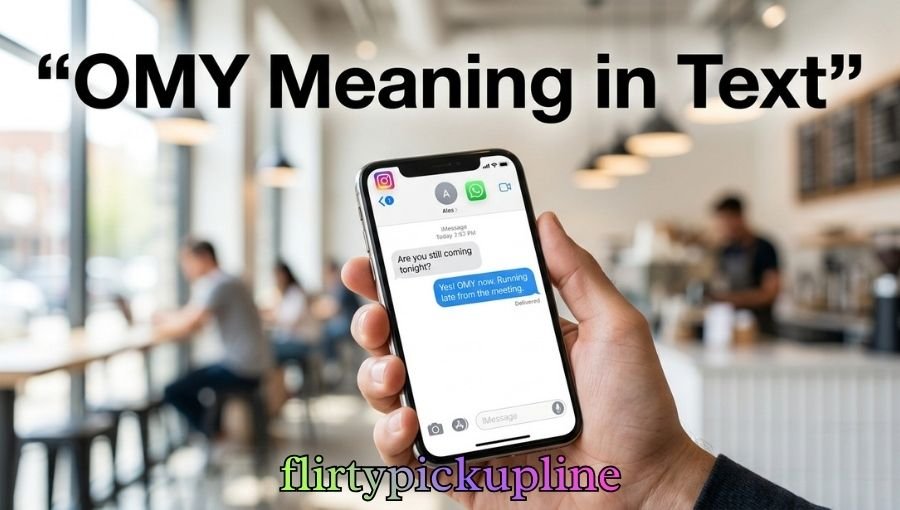
OMY Meaning in Text: Definition, Context, Examples, and Modern Usage (2026 Guide)
You’re texting a friend when they suddenly reply, “OMY 😭”. You understand the words around it, but those three letters leave you guessing. Is it excitement? Surprise? A typo? Or something completely different? That uncertainty is exactly why people look up OMY Meaning in Text.
Unlike common abbreviations such as LOL, BRB, or OMW, OMY doesn’t have one universally accepted definition across every texting community. Its meaning can change with the sentence, relationship, platform, and even the person’s typing habits.
In casual messages, OMY is often used as a shortened form of “Oh my”, especially when someone is reacting strongly to something. However, because the abbreviation isn’t standardized, you should always consider the surrounding words before deciding what the sender intended.
People also sometimes confuse OMY with OMW (“on my way”), particularly when messages are typed quickly. A small difference in letters can create a completely different message.
This guide explains OMY Meaning in Text, how the abbreviation works across social platforms, what its tone may suggest, and how to respond without misunderstanding it.
Quick Answer / Quick Definition of “OMY Meaning in Text”

OMY Meaning in Text usually refers to “Oh my”, an informal reaction showing surprise, shock, excitement, disbelief, or amusement. Its exact emotion depends on context. Because OMY isn’t a standardized texting abbreviation, it can occasionally represent another phrase or simply be a typo, so the surrounding message matters.
Also Read This: PPL Meaning In Text
Detailed Meaning Breakdown
Primary Meaning
The most natural interpretation of OMY in casual messaging is “Oh my.” It’s generally a reaction rather than a complete statement.
For example:
“OMY, that dress is gorgeous!”
Here, the sender is expressing pleasant surprise or admiration. In another conversation, the same abbreviation could introduce shock:
“OMY, what just happened?”
The phrase feels similar to saying “Oh my!” aloud. The shortened version simply saves typing time.
From my experience with online language, reaction abbreviations are especially dependent on punctuation and emojis. A crying face can make the same three letters feel playful, while a period may make them sound more serious.
Secondary Meanings
There isn’t a single official expansion that applies everywhere. Some users may use OMY as a personal shorthand, while others may type it when they actually mean OMW, or “on my way.”
For instance, someone might write:
“OMY to your house.”
If the conversation is about meeting up, the sender may have intended “OMW to your house.” In that situation, context strongly suggests a typing mistake.
Another possibility is that OMY forms part of a longer phrase or community-specific expression. This is uncommon, but it explains why dictionary-style definitions don’t always settle the question.
Rare or Misinterpreted Meanings
A common mistake is assuming every three-letter abbreviation has one fixed internet definition. OMY doesn’t work that way.
It isn’t safe to automatically interpret it as “on my way,” because that abbreviation is normally written as OMW. Nor should you assume OMY always expresses excitement.
The best approach is simple: read the complete message, check what was being discussed, and consider how that person normally texts.
What “OMY Meaning in Text” Means in Different Contexts
In Texting and Messaging
In ordinary texts, OMY commonly acts as an emotional reaction. It can signal surprise, amusement, disbelief, admiration, or mild shock.
For example:
“OMY, you actually bought it!”
This could sound amused and surprised if a friend bought something they had been discussing.
Compare that with:
“OMY, are you okay?”
Here, the feeling is concern rather than excitement.
That’s an important part of OMY Meaning in Text: the abbreviation itself doesn’t fully communicate the emotion. The words around it do.
On Social Media Platforms
On Instagram, OMY might appear in a comment reacting to a photo:
“OMY, this view!”
On Snapchat, it may be used in a quick chat reaction where speed matters more than formal grammar.
TikTok comments can make abbreviations especially expressive because users often combine them with slang, capitalization, repeated letters, or emojis. Threads tends to allow slightly longer conversational posts, so OMY may appear as part of a complete reaction.
The platform changes the style, but not necessarily the basic meaning. On social media, OMY generally works best as a casual emotional response.
In Dating and Relationships
In romantic conversations, OMY can sound playful, impressed, surprised, or flirtatious depending on what came before it.
For example:
“OMY 😳 You look amazing tonight.”
The emoji adds a shy or flirtatious layer.
But context matters. If someone writes:
“OMY, I can’t believe you said that.”
the same abbreviation may signal surprise or frustration instead.
Don’t treat OMY as an inherently romantic abbreviation. The relationship creates the romantic meaning, not the letters themselves.
In Professional Communication
OMY is generally too informal for most workplace messages, especially when communicating with clients, managers, customers, or people you don’t know well.
A casual team chat between close coworkers is different. Someone might write:
“OMY, that spreadsheet finally worked!”
Even there, a more professional phrase such as “Oh, wow!” may be clearer.
When clarity and professionalism matter, spelling out the reaction removes unnecessary ambiguity.
Cultural or Regional Differences
Online abbreviations don’t always follow strict regional rules. Age, friend groups, online communities, and personal habits can have more influence than geography.
A younger texter who frequently uses shorthand may immediately understand OMY. Someone who rarely uses texting abbreviations might find it confusing.
That’s why there isn’t a reliable American, British, or Australian definition that applies in every case. Personal usage matters.
Tone, Psychology & Why People Use It
Why People Use It & What It Signals Socially
People shorten expressions because texting is fast and conversational. OMY can make a reaction feel spontaneous rather than carefully written.
It can also create a sense of familiarity. Friends often develop their own shorthand, especially in fast-moving group chats.
I’ve noticed that short reaction phrases can sometimes communicate more personality than a full sentence. Capitalization, punctuation, and emojis often carry as much meaning as the abbreviation itself.
Emotional Layer Behind It
The tone may be:
- Friendly: “OMY, that’s hilarious 😂”
- Excited: “OMY!! You won!”
- Surprised: “OMY, I didn’t expect that.”
- Concerned: “OMY, what happened?”
- Cold or serious: “OMY. This is not good.”
The final example shows why punctuation matters. A period can remove some of the playful energy found in repeated exclamation marks or emojis.
10 Real Conversation Examples (Explained)
- Message: “OMY, that cake is huge!”
Meaning: The cake is surprisingly large.
Tone: Playful.
Interpretation: The sender is amused or impressed. - Message: “OMY 😳 you look incredible.”
Meaning: Strong admiration.
Tone: Flirty.
Interpretation: The sender may be attracted to the recipient. - Message: “OMY, did you hear the news?”
Meaning: A surprised introduction to new information.
Tone: Excited.
Interpretation: Something unexpected has happened. - Message: “OMY, I forgot the tickets.”
Meaning: The sender has suddenly realized a mistake.
Tone: Worried.
Interpretation: They may need help solving the problem. - Message: “OMY 😂 You actually posted that?”
Meaning: The sender finds the post surprising or funny.
Tone: Teasing.
Interpretation: Usually friendly among people who joke together. - Message: “OMY, this puppy is adorable.”
Meaning: An enthusiastic reaction to something cute.
Tone: Warm.
Interpretation: Genuine affection or delight. - Message: “OMY. We need to talk.”
Meaning: The sender is reacting seriously to something.
Tone: Tense.
Interpretation: The conversation may involve a problem. - Message: “OMY to the store now.”
Meaning: Potentially “on my way,” but probably a mistaken use of OMY.
Tone: Neutral.
Interpretation: Check the context before responding. - Message: “OMY, that ending was wild!”
Meaning: Strong reaction to a movie, show, or story.
Tone: Excited.
Interpretation: The sender is surprised by the ending. - Message: “OMY, you’re kidding me.”
Meaning: Disbelief about what was just said.
Tone: Shocked.
Interpretation: The sender needs clarification or confirmation.
Where Misunderstandings Happen
Context Confusion
The biggest problem is assuming OMY has one fixed definition. A reaction to a funny video differs from a response to bad news.
If you’re uncertain, ask a simple question: “What do you mean by OMY?” That’s much safer than guessing.
Generational Gap
Frequent texters may recognize shorthand immediately, while someone who prefers conventional writing may not.
Neither interpretation is necessarily wrong. The abbreviation simply isn’t universal.
Platform Differences
Social platforms encourage different writing styles. A TikTok comment can be extremely compressed, while a workplace chat may favor complete sentences.
The surrounding conversation remains the strongest clue.
Similar Words, Symbols, or Abbreviations
| Term | Meaning | How It Differs from OMY Meaning in Text |
|---|---|---|
| OMW | On my way | Usually indicates movement or arrival. |
| OMG | Oh my God | A stronger, more established reaction abbreviation. |
| OMFG | Oh my freaking/f***ing God | Much stronger and often profane. |
| WOW | Expression of surprise | A complete reaction word rather than an abbreviation. |
| LOL | Laughing out loud | Signals amusement rather than general surprise. |
| IDK | I don’t know | Expresses uncertainty, not emotional surprise. |
| WTF | What the f*** | Usually expresses strong shock, confusion, or anger. |
| OMG! | Oh my God | More widely recognized and usually more intense. |
When Not to Use “OMY Meaning in Text”
Professional Risks
Avoid unexplained abbreviations in formal emails, reports, customer communication, job applications, and important business discussions.
Even if you know what OMY means, the recipient may not.
Cultural Risks
Don’t assume everyone in a group shares the same internet vocabulary. Slang familiarity varies widely.
A clear phrase is better when you’re communicating across age groups or cultures.
Tone Risks
Short messages can sound harsher than intended. “OMY.” may appear serious or irritated when you meant playful surprise.
If the emotional tone matters, add enough words or punctuation to make your intention clear.
Expert Tips for Using “OMY Meaning in Text” Correctly
- Read the entire conversation first before deciding what OMY means.
- Look for clues such as emojis, punctuation, and capitalization.
- Don’t automatically confuse OMY with OMW.
- Use it mainly in casual conversations.
- Avoid unexplained shorthand in formal business writing.
- Consider the recipient’s age and familiarity with texting slang.
- If someone uses OMY unexpectedly, ask what they meant rather than guessing.
- Notice whether the surrounding words express excitement, concern, humor, or disbelief.
- Remember that personal texting habits can differ from common internet usage.
- When clarity matters more than speed, simply write “Oh my” or the complete reaction.
Frequently Asked Questions
1. What does OMY mean in text messages?
OMY most commonly means “Oh my” when used as a casual reaction. It can introduce surprise, excitement, concern, amusement, or disbelief. Because the abbreviation isn’t universally standardized, the sentence surrounding it matters. In some messages, especially those about travel or meeting someone, it may instead be a typo for OMW, meaning “on my way.”
2. Is OMY positive or negative?
OMY can be either positive or negative. “OMY, that looks amazing!” is clearly positive, while “OMY, what happened?” may express concern. The abbreviation itself doesn’t carry a fixed emotional value. Look at the words, punctuation, and emojis around it to understand whether the sender sounds happy, shocked, worried, or amused.
3. Can OMY have a romantic meaning?
Yes, but only through context. Someone might use OMY in a flirtatious message such as “OMY 😳 you look amazing.” However, OMY isn’t specifically a dating abbreviation. A romantic interpretation comes from the message, relationship, emojis, and conversation rather than from the three letters alone.
4. What should I reply when someone texts OMY?
Your response should match the apparent emotion. If they’re excited, you can respond enthusiastically. If they’re confused or worried, explain what happened. When the meaning isn’t obvious, asking “Wait, what do you mean?” is perfectly natural. A short clarification is better than building a response around the wrong interpretation.
5. Is OMY the same as OMW?
No. OMW is the established abbreviation for “on my way,” while OMY is commonly understood as “Oh my” in informal reactions. However, people can make typing mistakes, so OMY may occasionally appear where OMW was intended. The subject of the conversation usually reveals which interpretation makes sense.
6. Is OMY common slang?
OMY is less standardized and less universally recognized than abbreviations such as OMG, LOL, BRB, or OMW. Some people use it naturally, while others may not recognize it immediately. That’s why context is especially important when interpreting the expression.
7. Does OMY mean “Oh my God”?
Not necessarily. OMY is generally closer to “Oh my” than the established abbreviation OMG, which means “Oh my God.” A person may intend a similar emotional reaction without using the religious wording contained in OMG. Don’t automatically expand OMY into OMG unless the context clearly supports it.
8. Can OMY be used in professional messages?
It’s better to avoid it in formal professional communication. Even if coworkers understand the abbreviation, it can look overly casual or unclear in client emails, official notices, reports, and business correspondence. In a workplace, writing the full reaction is usually the safer choice.
Final Summary & Smart Usage Advice
Understanding OMY Meaning in Text is less about memorizing three letters and more about reading the situation around them.
In casual communication, OMY is commonly used as a shortened “Oh my” reaction. It can express surprise, excitement, amusement, admiration, disbelief, or concern. The emotional meaning comes from the surrounding words, punctuation, emojis, and relationship between the people talking.
It’s also worth remembering that OMY isn’t as standardized as popular abbreviations such as OMG or OMW. If someone writes “OMY” when discussing travel or meeting plans, they may simply have mistyped OMW. Don’t force a definition that doesn’t fit the conversation.
For friends, social media comments, DMs, and relaxed group chats, OMY can work as quick expressive shorthand. For professional or unfamiliar audiences, spelling out your reaction is clearer.
If you remember only one thing, remember this: OMY usually means “Oh my,” but context decides the emotion—and sometimes even the intended phrase.

Hi, I’m Ryan Mitchell. I work at FlirtyPickUpLine.com, writing about slang, abbreviations, and everyday expressions. I focus on making each meaning clear, useful, and easy to follow.