Torta Meaning in Slang: Definition, Context, Examples, and Modern Usage (2026 Guide)
You see a friend comment, “She’s such a torta,” and pause. Is it a compliment? An insult? A joke between friends? Or does it simply mean food? That confusion is exactly why searches for Torta Meaning in Slang keep coming up.
The word torta has several meanings across Spanish-speaking cultures, and its slang use can change sharply depending on the country, community, speaker, and situation.
In Mexican Spanish, torta most commonly refers to a type of sandwich made with a bread roll, and it can also mean a cake or similar baked food in other Spanish varieties. But in some Mexican and Mexican-American slang contexts, torta can be used as a slang label for a lesbian woman, sometimes carrying a teasing, informal, or derogatory tone.
That distinction matters. A word that sounds harmless in a restaurant can mean something completely different in a social-media comment.
The safest way to understand the Torta Meaning in Slang is to look beyond the dictionary and examine who said it, where they said it, and what the surrounding conversation suggests.
Quick Answer / Quick Definition of “Torta Meaning in Slang”

Torta can have a slang meaning in some Mexican and Mexican-American communities, where it may refer to a lesbian woman. The tone can range from teasing or familiar to insulting, depending on the speaker and context. Outside slang, torta commonly means a sandwich in Mexican Spanish and can mean cake in other Spanish-speaking regions.
In other words, the Torta Meaning in Slang isn’t universal. Context determines whether the word is food-related, descriptive, playful, or offensive.
Also Read This: PMO Slang Meaning
Detailed Meaning Breakdown
Primary Meaning
The primary slang sense associated with torta in certain Mexican and Mexican-American contexts is a lesbian woman.
This isn’t necessarily how every Spanish speaker understands the word. In fact, many Spanish speakers may hear torta and immediately think of food. That’s one of the biggest sources of confusion for English-speaking readers encountering the term online.
When torta is used about a person, the surrounding language becomes especially important. A sentence describing someone’s romantic preferences, appearance, or relationship may make the slang meaning obvious.
For example, someone might say, “They’ve been calling her a torta since high school.” Here, the word isn’t referring to lunch or dessert. It’s being used as a social label.
My observation is that speaker identity matters almost as much as the word itself. Slang often belongs to a particular community rather than to a language as a whole.
Secondary Meanings
Outside slang, torta has several ordinary meanings.
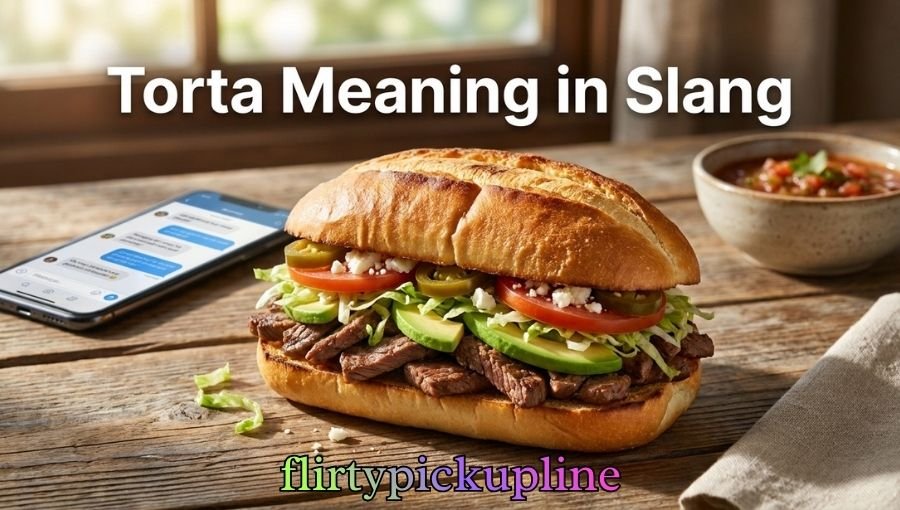
In Mexican Spanish, a torta is commonly a sandwich served on a bread roll, often filled with meat, cheese, avocado, beans, vegetables, or other ingredients. The exact preparation varies by region.
In some other Spanish-speaking countries, torta refers to a cake, pastry, or baked dish. So someone saying, “Vamos a comer torta,” could simply be talking about food.
There’s also a famous regional difference in Spain, where related food terminology doesn’t always line up neatly with Mexican usage.
This is why translating the word without context can produce an inaccurate result. A dictionary definition may tell you what torta can mean, but it won’t necessarily tell you what a particular speaker intended.
Rare or Misinterpreted Meanings
Some online users assume every appearance of torta is slang. That’s incorrect.
If you see phrases involving food, restaurants, cooking, birthdays, bread, fillings, or desserts, the ordinary meaning is usually the better interpretation.
Another mistake is assuming that the slang definition applies equally throughout the Spanish-speaking world. It doesn’t.
The Torta Meaning in Slang is strongly influenced by regional usage. A person from Mexico may recognize a slang sense that someone from Argentina, Spain, Colombia, or another Spanish-speaking community doesn’t use in the same way.
It’s also worth avoiding the assumption that the term is automatically offensive. Some slang labels can be reclaimed or used casually within particular communities. The same word can feel very different when used by an outsider.
What “Torta Meaning in Slang” Means in Different Contexts
In Texting and Messaging
Text messages remove many clues that normally help us understand slang. You can’t hear the speaker’s voice or see their facial expression, so a word such as torta can be especially ambiguous.
Consider a message such as:
“Did you hear? Marco called her a torta.”
That wording suggests the speaker is discussing a label applied to another person. The next messages would determine whether the term is being repeated critically, jokingly, or descriptively.
By contrast:
“I’m making tortas tonight.”
Almost certainly refers to food if the conversation is about dinner.
A useful rule is simple: look at the subject of the conversation before translating the word.
In casual texting, friends may also use slang more freely than they would in public. A nickname or teasing term might be acceptable inside one friendship but inappropriate when repeated to strangers.
On Social Media Platforms
Social platforms add another layer because users often write without explaining regional slang.
On Instagram, torta might appear in a caption, comment, or private message. A comment about someone’s identity or dating life may point toward the slang meaning, while a food photo usually points toward the literal one.
On Snapchat, the meaning may depend heavily on the private relationship between users. Short messages and inside jokes can make translation difficult.
On TikTok, regional slang can spread quickly beyond its original community. A viewer may encounter torta in a joke, skit, meme, or comment and assume the meaning is universal when it isn’t.
Threads can produce a similar problem, particularly when a short post gets shared outside its original cultural context.
One thing I’ve noticed with social slang is that virality often strips away context. A local expression can travel thousands of miles before most readers understand where it came from.
In Dating and Relationships
Relationship conversations are one setting where the slang meaning can become particularly clear.
If someone says, “She’s a torta,” while discussing a woman’s attraction to women, the term is likely being used as a slang reference to lesbian identity or behavior.
However, that doesn’t automatically make the statement respectful.
The speaker’s relationship to the person matters. A close friend may use a community-specific expression affectionately or jokingly. A stranger using the same term about someone’s sexuality can sound invasive or insulting.
For someone learning Spanish slang, it’s better to understand the expression before trying to use it. Recognition is useful; casually adopting a potentially sensitive label is another matter.
In Professional Communication
This is where caution is essential.
Using torta as a slang label for a person’s sexuality in a workplace, job application, business email, customer interaction, or formal meeting is generally a poor choice.
Even if you know people who use the term casually, professional communication requires language that is clear and respectful across different backgrounds.
If discussing sexual orientation is genuinely relevant, neutral wording such as lesbian woman is far safer and more precise in English.
The food meaning is completely different. Saying “We ordered tortas for lunch” isn’t a sexuality reference when the context clearly concerns food.
Cultural or Regional Differences
Regional variation is probably the most important part of understanding the Torta Meaning in Slang.
Mexican Spanish has many expressions that don’t translate directly into American English. Mexican-American communities may also develop hybrid forms of slang influenced by English, Spanish, family traditions, and local culture.
Age can matter too. A younger speaker may encounter a word through TikTok or memes without knowing its historical or regional background. An older speaker may recognize a completely different use.
There’s another wrinkle: not every Mexican speaker uses every slang term. Mexico itself contains enormous regional and social variation.
So rather than asking, “What does torta always mean?” a better question is, “What does torta mean in this particular conversation?”
Tone, Psychology & Why People Use It
Why People Use It & What It Signals Socially
Slang often works as a marker of group identity.
People use informal vocabulary to signal familiarity, humor, shared culture, or belonging. A word can carry social information that a neutral dictionary synonym doesn’t.
When torta is used as a slang label, the speaker may be trying to be humorous, casual, provocative, affectionate, or insulting.
The word alone doesn’t tell you which one.
This is especially true when slang has been used for a long time within a community. People familiar with the expression may hear a tone that outsiders miss.
Emotional Layer Behind It
A friendly tone might appear between close friends:
“Girl, you’re such a torta 😂”
Even then, only the relationship between the speakers can tell you whether that is affectionate teasing.
A neutral discussion might simply report the word:
“That’s a term some people use for a lesbian woman.”
A hostile use can be more direct:
“Don’t call her that.”
Here, the speaker is clearly rejecting the label.
The safest interpretation is therefore context first, emotion second, vocabulary third. If the relationship between speakers is unknown, don’t automatically assume the word is friendly.
10 Real Conversation Examples (Explained)
1. Food Context
Message: “Let’s grab tortas after work.”
Intended meaning: Mexican-style sandwiches.
Tone: Friendly and casual.
Likely interpretation: The conversation is about food, not slang.
2. Identity Discussion
Message: “Some people around here use torta for a lesbian woman.”
Intended meaning: The speaker is explaining a regional slang term.
Tone: Informational.
Likely interpretation: The word is being discussed rather than directed at someone.
3. A Teasing Friend
Message: “You two are always together. Torta energy 😂”
Intended meaning: A joking reference to perceived romantic or sexual attraction between women.
Tone: Teasing.
Likely interpretation: Playful if the friends already share that kind of humor; uncomfortable otherwise.
4. An Argument
Message: “Why did you call her a torta?”
Intended meaning: The speaker is challenging someone’s use of the slang label.
Tone: Confrontational.
Likely interpretation: The term was considered inappropriate or offensive.
5. A Restaurant Post
Message: “Best torta I’ve had all year.”
Intended meaning: A sandwich or regional food item.
Tone: Positive.
Likely interpretation: Food, especially if accompanied by a restaurant photo.
6. A Language-Learning Question
Message: “I heard someone say torta. Does it mean lesbian?”
Intended meaning: Asking about slang.
Tone: Curious.
Likely interpretation: The writer isn’t using the term toward another person; they’re asking for clarification.
7. A Private Joke
Message: “Here comes the torta 😭”
Intended meaning: Could be an inside joke or slang label.
Tone: Potentially playful.
Likely interpretation: Impossible to determine confidently without knowing the relationship and preceding conversation.
8. A Dating Conversation
Message: “She told me she’s into women, and her cousin called her a torta.”
Intended meaning: The cousin used the slang term in reference to her sexuality.
Tone: Depends on the cousin’s intent.
Likely interpretation: A regional or community-specific label rather than a literal food reference.
9. A Social-Media Comment
Message: “Tortas ❤️”
Intended meaning: Ambiguous.
Tone: Could be affectionate, humorous, or food-related.
Likely interpretation: The image or video is essential. Without it, guessing would be risky.
10. A Workplace Conversation
Message: “Someone used torta to describe our coworker.”
Intended meaning: Reporting potentially inappropriate slang about the coworker’s sexuality.
Tone: Serious.
Likely interpretation: The term should not be repeated casually in a professional environment.
Where Misunderstandings Happen
Context Confusion
The biggest problem is that one spelling can point to completely different meanings.
A food conversation and an identity conversation may use exactly the same word. Without surrounding clues, translation software or a quick dictionary lookup may not resolve the ambiguity.
Before interpreting slang, check the nouns, verbs, images, hashtags, and previous messages around it.
Generational Gap
Slang changes.
A teenager who discovers an expression through short-form video may use it differently from someone who learned Spanish at home decades ago.
Older speakers may also recognize regional expressions that younger users rarely use. The reverse happens too.
Don’t assume that one person’s definition represents an entire language community.
Platform Differences
The same expression can feel different on different platforms.
A restaurant post gives strong food-related clues. A private DM may rely on an inside joke. A viral TikTok comment can remove the original cultural context entirely.
When a slang term appears in isolation, ask what the post is actually about before deciding what it means.
Similar Words, Symbols, or Abbreviations
| Term | Meaning | How It Differs from Torta |
|---|---|---|
| Lesbian | A woman attracted to women | Neutral English identity term |
| Queer | Broad LGBTQ+ identity term | Much broader than the slang use of torta |
| Gay | Same-sex attraction; often used broadly | Doesn’t specifically identify a lesbian woman |
| LGBTQ+ | Umbrella term for sexual and gender identities | Refers to a broad community, not one identity |
| Butch | Masculine-presenting or masculine-identified person, often in lesbian contexts | Describes presentation or identity, not simply sexual orientation |
| Stud | Masculine-presenting identity used in some Black lesbian communities | Culturally specific and not interchangeable with torta |
| Sapphic | Relating to women attracted to women | More literary or broad than the slang term |
| Torta | Regional food term and, in some contexts, slang | Meaning changes dramatically with context |
When Not to Use “Torta Meaning in Slang”
Professional Risks
Don’t use a regional slang label for someone’s sexuality at work simply because you’ve heard it online.
Even when your intention is humorous, another person may experience it as disrespectful. Professional communication should favor clear, neutral language.
The food meaning presents no comparable issue when the subject is genuinely food.
Cultural Risks
Using slang from a culture you don’t belong to can sometimes sound forced or mocking, especially when pronunciation or context is unfamiliar.
Learning the word is perfectly reasonable. You don’t have to use it yourself.
That distinction can save you from an awkward situation.
Tone Risks
Slang can be affectionate among friends and offensive from a stranger.
That’s particularly relevant when the word refers to someone’s sexual orientation. If you aren’t sure how a person feels about the term, choose a neutral alternative.
Expert Tips for Using “Torta Meaning in Slang” Correctly
- Check the country first. Spanish slang varies dramatically across regions.
- Read the surrounding messages. The topic often reveals the intended meaning.
- Look for food clues. Restaurants, recipes, bread, fillings, and meals usually signal the literal meaning.
- Don’t assume slang is universal. A term familiar in one community may be unknown elsewhere.
- Consider the speaker. Community membership can affect how an expression is understood.
- Watch the tone. Jokes, insults, affectionate teasing, and neutral descriptions can sound very different.
- Use neutral language professionally. If sexuality is relevant, “lesbian” is clearer in English.
- Don’t infer someone’s sexuality from a slang word alone. Context can be incomplete or misleading.
- Ask politely when necessary. “What do you mean by torta here?” is better than making a confident guess.
- Learn before repeating. Understanding a slang term doesn’t mean you need to adopt it.
Frequently Asked Questions
1. What does torta mean in slang?
In some Mexican and Mexican-American slang contexts, torta can refer to a lesbian woman. The expression is not universally used or understood that way. In many ordinary Spanish conversations, torta refers to food instead, particularly a sandwich in Mexico. Context, region, and speaker background determine the intended meaning.
2. Is torta a positive or negative word?
It can be either, depending on who uses it and how. Within a close group, a slang expression may be playful or familiar. Used by an outsider, it can sound disrespectful or derogatory. Because the emotional meaning isn’t fixed, the safest approach is to avoid assuming that torta is automatically positive or automatically offensive.
3. Can torta have a romantic meaning?
Yes, in the relevant slang context, it can relate to women who are attracted to women. That doesn’t mean every romantic use of torta has this meaning, however. Spanish-speaking communities use the word literally for food as well, so a dating-related conversation provides an important clue when determining the intended sense.
4. How should I respond if someone calls me a torta?
Your response can depend on how you feel and what you think the person intended. If you’re confused, ask, “What do you mean by that?” If you dislike the label, you can say so directly. There’s no requirement to accept a slang term simply because someone else considers it harmless.
5. Does torta mean lesbian in all Spanish-speaking countries?
No. This is one of the most important distinctions to remember. Slang is regional, and the same Spanish word can have very different associations across countries and communities. In many places, torta will primarily be understood as a food word. You should identify the speaker’s regional background before applying a slang definition.
6. Does torta always refer to sexuality when used about a person?
Not necessarily. Personal nicknames, jokes, local expressions, and private slang can create meanings that aren’t obvious from a dictionary. If torta appears in a sentence about a person, examine the surrounding conversation rather than immediately assuming it refers to sexual orientation.
7. Why does torta sometimes mean sandwich?
Torta has ordinary food meanings that developed independently from the slang sense. In Mexican Spanish, it commonly refers to a sandwich made with a bread roll and various fillings. This everyday meaning is extremely common, which is why context is essential when an English-speaking reader encounters the word online.
8. Is torta the same as lesbian?
No. Lesbian is a standard English identity term. Torta is a regional slang expression with additional meanings, including food. Even when someone uses it to refer to a lesbian woman, the words aren’t interchangeable in every situation. “Lesbian” is generally the clearer and more neutral choice when discussing sexual orientation.
Final Summary & Smart Usage Advice
The key to understanding the Torta Meaning in Slang is recognizing that torta has more than one life.
In Mexican Spanish, the everyday meaning is often a sandwich. In other Spanish-speaking settings, it can refer to a cake or another type of food. In certain Mexican and Mexican-American slang contexts, it can also be used as a label for a lesbian woman.
Those meanings aren’t interchangeable.
If you encounter the word in a restaurant post, recipe, food review, or dinner conversation, the literal meaning is usually the obvious choice. If it appears in a conversation about dating, sexuality, identity, or relationships, the slang interpretation may be relevant.
Still, don’t rely on the word alone. Region, speaker, relationship, platform, and tone all matter.
When you’re unsure, asking for clarification is smarter than guessing. And when you’re speaking professionally or with someone whose preferences you don’t know, neutral language is the safest option.
The most common mistake is treating one regional slang definition as though it applies to every Spanish speaker. It doesn’t.
The memorable rule: with “torta,” context isn’t a detail—it determines the meaning.

Hi, I’m Lucas Anderson. I work at FlirtyPickUpLine.com, writing simple articles about modern slang, texting language, and word meanings. I enjoy helping readers understand new terms quickly.