IDFK Meaning in Text: Definition, Context, Examples, and Modern Usage (2026 Guide)
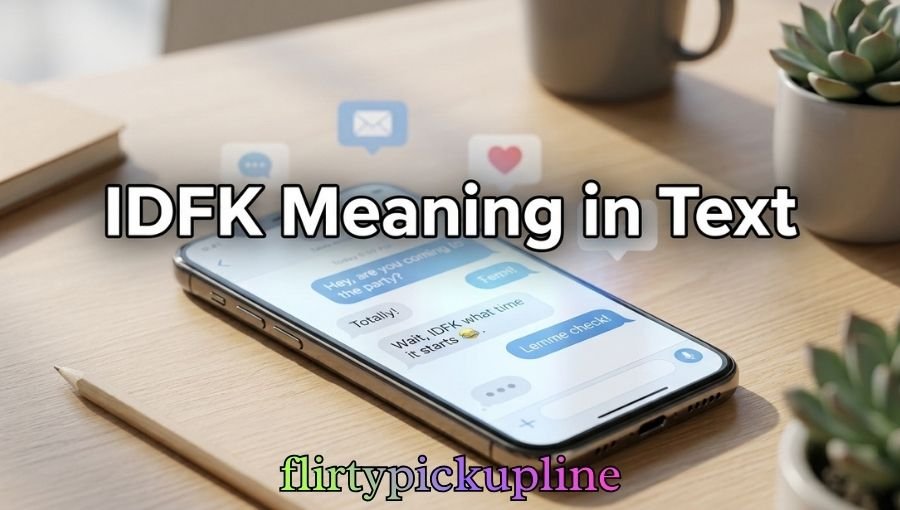
You get a message from a friend asking, “Are you still coming tonight?” You type back, “IDFK, I might be late.” If you’ve seen IDFK meaning in text searches lately, you may already know the feeling: the abbreviation looks familiar, but its exact tone isn’t always obvious.
IDFK is common in casual digital communication, especially among people who use texting, social media, and internet slang regularly. Its popularity comes from the same place as many other abbreviations: people want to communicate quickly without typing a full sentence. Still, context matters. A short “IDFK” can sound casual and honest in one conversation but irritated or dismissive in another.
The good news is that the basic meaning is simple. Once you understand the words behind the abbreviation and the tone it can carry, reading or using it becomes much easier.
Quick Answer / Quick Definition of “IDFK Meaning in Text”

IDFK usually means “I don’t f*ing know”** in text messages. The F-word makes it stronger and more emotional than “IDK,” or “I don’t know.” People generally use it to express uncertainty, frustration, annoyance, or emphasis in casual conversations. In short, IDFK means “I really don’t know.”
Also Read This: Chalant Mean in Text
Detailed Meaning Breakdown
Primary Meaning
The primary IDFK meaning in text is “I don’t f***ing know.” It is an intensified version of IDK, which simply means “I don’t know.”
The added F-word changes the emotional force. Compare these:
- IDK: “I don’t know.”
- IDFK: “I really don’t know.”
- I have no idea: “I’m uncertain.”
- IDFK anymore: “I’m extremely unsure or frustrated.”
The abbreviation isn’t normally intended as a literal statement about someone’s knowledge. Often, it adds emotion to an otherwise ordinary answer.
One small detail makes a big difference: the F-word is generally considered profanity, even though it’s abbreviated.
Secondary Meanings
In some conversations, IDFK can function less as a direct answer and more as an emotional reaction.
For example:
“IDFK why he would do that.”
Here, the speaker may know part of the situation but feels confused or annoyed by it.
Likewise:
“IDFK what to tell you.”
This can communicate uncertainty mixed with helplessness.
So, when considering IDFK meaning in text, don’t translate every use word-for-word. The practical meaning may be closer to “I honestly have no clue,” “I seriously don’t know,” or “I’m confused too.”
Rare or Misinterpreted Meanings
IDFK isn’t normally a secret code, romantic abbreviation, or special acronym with a completely unrelated everyday definition.
Some readers may mistake it for a typo of IDK. Usually, however, the extra F is intentional. It adds intensity.
It’s also easy to assume that every IDFK sounds angry. That’s not necessarily true. Friends may use it jokingly or casually:
“IDFK 😂 Ask Jake.”
The surrounding conversation determines whether the phrase feels playful, annoyed, frustrated, or simply emphatic.
What “IDFK Meaning in Text” Means in Different Contexts
In Texting and Messaging
In ordinary texting, IDFK is usually used when someone doesn’t know an answer and wants to emphasize that uncertainty.
For example:
“What time does the movie start?”
“IDFK, check the ticket.”
The second person isn’t necessarily upset. They’re simply saying they don’t have the information.
Another example:
“Why is my phone doing this?”
“IDFK lol.”
Here, the abbreviation can create a relaxed, informal tone.
When people search for IDFK meaning in text, they’re often trying to determine whether the sender is being rude. Usually, the abbreviation itself isn’t enough to establish that. The relationship, punctuation, previous messages, and topic all matter.
On Social Media Platforms
On Instagram, Snapchat, TikTok, and Threads, IDFK can appear in captions, comments, DMs, and stories.
A TikTok comment might say:
“IDFK how she did that.”
An Instagram story could say:
“IDFK what I’m wearing tonight.”
A Snapchat message might use:
“IDFK, you decide.”
Threads can also use the abbreviation in conversational posts where the writer wants to sound informal or blunt.
Platform culture can influence the tone. Public comments often use abbreviations for humor or emphasis, while private DMs can make them feel more personal. Snapchat conversations, in particular, tend to favor quick shorthand because messages are often fast and casual.
In Dating and Relationships
IDFK can appear in romantic conversations when someone is uncertain about plans, feelings, or another person’s behavior.
For example:
“Do you think he’s actually interested?”
“IDFK. He keeps giving mixed signals.”
That doesn’t necessarily mean the person is angry. It may show confusion or emotional uncertainty.
A partner might also write:
“IDFK what we should do this weekend.”
That’s usually harmless and practical.
However, replying with only “IDFK” to a serious emotional question can feel dismissive. If someone asks, “Do you still want this relationship?” an unexplained abbreviation may come across as cold rather than casual.
In Professional Communication
IDFK is generally unsuitable for formal workplace communication because it contains abbreviated profanity.
A coworker asking, “Do you know when the report is due?” shouldn’t normally receive “IDFK.”
A better response would be:
“I’m not sure. I’ll check and let you know.”
The professional equivalent preserves the uncertainty without the profanity.
This distinction is easy to overlook when people use casual language all day. Workplace communication has different expectations, especially with clients, managers, recruiters, and customers.
Cultural or Regional Differences
The core expression is widely understood in English-language internet culture, particularly in the United States, but comfort with profanity varies.
Age also matters. Younger internet users may recognize IDFK immediately, while someone less familiar with texting slang may simply see it as confusing or inappropriate.
The abbreviation doesn’t have one universal emotional meaning. Some people use profanity casually; others consider it strongly offensive. When in doubt, assume the abbreviated F-word can still be perceived as profanity.
Tone, Psychology & Why People Use It
Why People Use It & What It Signals Socially
The main attraction is efficiency. Typing four letters is faster than writing “I don’t freaking know” or the uncensored phrase.
But speed isn’t the only reason. IDFK can signal stronger uncertainty, frustration, disbelief, or emotional intensity.
Someone who says:
“IDK.”
sounds relatively neutral.
Someone who says:
“IDFK.”
may be communicating, “I genuinely have no idea, and this is getting frustrating.”
I’ve noticed that short internet abbreviations often work like vocal emphasis. The letters are doing more than saving time; they’re helping convey attitude.
Emotional Layer Behind It
The tone can range from friendly to cold.
Friendly:
“IDFK 😂 Maybe ask Sam.”
Neutral-ish:
“IDFK. I wasn’t there.”
Frustrated:
“IDFK why you keep asking me.”
Cold or dismissive:
“IDFK.”
The final example is especially dependent on context. A one-word response can feel much harsher than the same abbreviation inside a longer sentence.
10 Real Conversation Examples (Explained)
- Message: “IDFK what time we’re leaving.”
Meaning: The sender doesn’t know the departure time. Tone: Casual. Interpretation: Usually harmless uncertainty. - Message: “IDFK why he blocked me.”
Meaning: The sender is confused about someone’s behavior. Tone: Frustrated. Interpretation: They may want emotional support. - Message: “IDFK 😂 You pick the restaurant.”
Meaning: The sender doesn’t have a preference. Tone: Playful. Interpretation: They’re leaving the choice to you. - Message: “IDFK anymore.”
Meaning: The person feels deeply uncertain about something. Tone: Potentially emotional. Interpretation: Context may suggest distress rather than simple ignorance. - Message: “Where’s the charger?” / “IDFK.”
Meaning: They don’t know where it is. Tone: Neutral or blunt. Interpretation: The short reply may feel slightly dismissive. - Message: “IDFK if I should text her.”
Meaning: The sender is unsure about making contact. Tone: Hesitant. Interpretation: They may be asking indirectly for advice. - Message: “IDFK how you pulled that off.”
Meaning: The speaker is surprised or impressed. Tone: Informal and possibly humorous. Interpretation: It isn’t necessarily negative. - Message: “IDFK, ask the manager.”
Meaning: The sender doesn’t have the answer. Tone: Direct. Interpretation: They are redirecting the question. - Message: “IDFK why you’re mad at me.”
Meaning: The sender doesn’t understand the conflict. Tone: Defensive or confused. Interpretation: The relationship context matters greatly. - Message: “IDFK what this assignment wants.”
Meaning: The student doesn’t understand the task. Tone: Frustrated. Interpretation: They may be looking for help rather than ending the conversation.
Where Misunderstandings Happen
Context Confusion
The biggest problem is assuming that the abbreviation automatically means anger.
It doesn’t. IDFK can simply intensify “I don’t know.” Look at the surrounding words before judging the sender’s attitude.
Generational Gap
People who regularly use online slang may interpret IDFK as ordinary casual language. Someone unfamiliar with texting abbreviations may see the profanity first and consider it rude.
That difference can create unnecessary tension.
Platform Differences
A public TikTok comment may use IDFK humorously, while the same response in a serious private conversation could sound dismissive.
The platform doesn’t change the dictionary meaning. It can, however, influence how the message is perceived.
Similar Words, Symbols, or Abbreviations
| Term | Meaning | How It Differs from IDFK Meaning in Text |
|---|---|---|
| IDK | I don’t know | Neutral and less profane |
| IDC | I don’t care | Expresses indifference, not uncertainty |
| IMO | In my opinion | Introduces a personal view |
| TBH | To be honest | Signals frankness rather than lack of knowledge |
| WTF | What the f*** | Usually expresses surprise, anger, or confusion |
| SMH | Shaking my head | Shows disapproval or disbelief |
| NVM | Never mind | Withdraws or dismisses a previous point |
| I have no clue | I don’t know | Similar meaning without profanity |
| Dunno | Don’t know | Casual but generally much softer |
When Not to Use “IDFK Meaning in Text”
Professional Risks
Avoid IDFK in job applications, business emails, customer service messages, academic communication, and formal workplace chats.
Even if everyone understands it, the profanity can undermine your professionalism.
Cultural Risks
Don’t assume everyone has the same tolerance for swear words. Parents, teachers, older relatives, clients, and people from more formal cultures may interpret the abbreviation more negatively.
Tone Risks
Avoid using a bare “IDFK” when someone is sharing something serious.
If a friend asks for help with a painful personal issue, a more thoughtful response is usually better than a four-letter abbreviation.
Expert Tips for Using “IDFK Meaning in Text” Correctly
- Use it with people who understand casual slang.
- Remember that the F stands for profanity.
- Don’t use it in formal or professional writing.
- Read the surrounding conversation before interpreting the tone.
- Add context if your answer could sound dismissive.
- Use punctuation carefully; a period can make a short reply feel firmer.
- Use humor only when the relationship supports it.
- Don’t assume IDFK always signals anger.
- Choose “IDK” when you want a softer version.
- For serious conversations, answer the actual question instead of relying on shorthand.
Frequently Asked Questions
1. What does IDFK mean in texting?
IDFK usually means “I don’t f*ing know.”** It’s an intensified form of IDK and is used when someone wants to express strong uncertainty, frustration, confusion, or emphasis. The exact emotional tone depends on the conversation. Between close friends, it can be casual; in a serious discussion, it may sound blunt.
2. Is IDFK a bad word?
The abbreviation itself isn’t a separate swear word, but the F represents profanity. For that reason, IDFK is generally considered informal and mildly to strongly inappropriate depending on the audience. Friends may use it freely, while professional, family, school, or formal settings may call for a cleaner alternative.
3. Is IDFK the same as IDK?
Not quite. Both communicate that the speaker doesn’t know something, but IDFK is more emphatic because of the added profanity. IDK is usually neutral and broadly acceptable in casual communication. If you simply don’t know an answer, IDK is the safer abbreviation; IDFK adds emotional force.
4. Can IDFK have a romantic meaning?
IDFK doesn’t have a special romantic definition. However, it can appear in dating conversations when someone is uncertain about a relationship, another person’s feelings, or what decision to make. In those situations, the emotional meaning comes from the surrounding conversation rather than from the abbreviation itself.
5. Is IDFK rude?
It can be. The letters may sound perfectly normal among close friends but inappropriate when directed at a stranger, coworker, teacher, customer, or someone discussing a serious issue. A useful rule is to consider relationship, topic, and setting before deciding whether the expression will feel casual or disrespectful.
6. How should I respond when someone texts IDFK?
Your response should match the situation. If they’re answering a simple question, you can ask someone else or move on. If they’re frustrated, you might ask, “Want me to help figure it out?” When the message is vague, don’t automatically assume they’re angry. Context is your best guide.
7. Why do people type IDFK instead of “I don’t know”?
The abbreviation saves time while adding emphasis. The profanity can communicate that the person really doesn’t know, is frustrated by the question, or feels confused about the situation. It’s similar to stressing a word while speaking. The letters are short, but they can carry more attitude than a plain “I don’t know.”
8. What is a softer alternative to IDFK?
Use IDK, “I’m not sure,” “I have no idea,” or “I honestly don’t know.” These options preserve the basic message without the profanity. “I’m not sure” works particularly well when you’re speaking to someone you don’t know well or when the conversation needs to remain polite and professional.
Final Summary & Smart Usage Advice
Understanding IDFK meaning in text is straightforward once you separate its literal meaning from its tone. The abbreviation generally means “I don’t f*ing know,”** making it a stronger, more emotional version of “IDK.”
People use it in texts, DMs, comments, captions, and other casual online conversations. Depending on the situation, it can express ordinary uncertainty, frustration, confusion, disbelief, or even playful exaggeration. A message such as “IDFK 😂” may be lighthearted, while “IDFK” sent during an argument can feel cold or dismissive.
The safest approach is to consider who sent it, what you’re discussing, and how the rest of the message sounds. Don’t automatically interpret the abbreviation as anger. At the same time, don’t forget that the hidden F is still profanity.
For professional or sensitive conversations, choose a cleaner phrase such as “I’m not sure” or “I don’t know.” Among close friends, the stronger shorthand may be perfectly natural.
If someone asks about IDFK meaning in text, the simplest answer is this: it’s an emphatic way to say “I don’t know,” with tone supplied by the context.
Memorable takeaway: IDFK means “I really don’t know”—but the conversation tells you how strongly to read it.

Hi, I’m Liam Carter. I work at FlirtyPickUpLine.com, creating easy-to-read articles about slang, texting terms, and their meanings. I like explaining modern language in a simple way.