Chalant Mean in Text Meaning: Definition, Context, Examples, and Modern Usage (2026 Guide)
You get a text from someone you’ve been talking to: “I’m actually chalant about you.” You pause. Is that a typo? A joke? A new piece of slang? If you searched Chalant Mean in Text, you’re probably trying to figure out exactly what the sender intended.
The word has become more visible in casual online conversations because people enjoy turning familiar words into playful opposites. Chalant is commonly used online as an informal, humorous counterpart to nonchalant. Instead of acting detached or uninterested, a person described this way is usually showing that they care, notice, or have strong interest.
The catch is that chalant isn’t standard formal English in the same way nonchalant is. Its meaning depends heavily on context, tone, and the person using it.
That makes this little word surprisingly interesting. I’ve found that the surrounding sentence often tells you more than the word itself.
Below, we’ll break down its meaning, show how it works in texts and social media, and explain when using it can create confusion.
Quick Answer / Quick Definition of “Chalant Mean in Text”
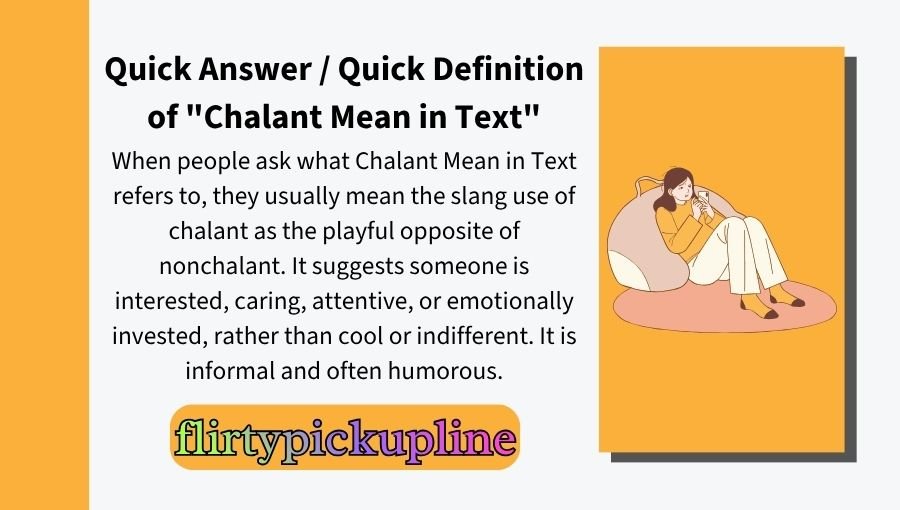
When people ask what Chalant Mean in Text refers to, they usually mean the slang use of chalant as the playful opposite of nonchalant. It suggests someone is interested, caring, attentive, or emotionally invested, rather than cool or indifferent. It is informal and often humorous.
Also Read This: NMMS Meaning in Text
Detailed Meaning Breakdown
Primary Meaning
The simplest definition of chalant in online language is showing that you care or are interested.
For example:
“He’s not acting nonchalant anymore. He’s fully chalant.”
The speaker probably means that the person has stopped hiding his feelings and is openly showing interest.
This use comes from the structure of nonchalant. Since non- can suggest negation, internet users sometimes jokingly remove it and treat chalant as an independent word.
That logic isn’t how English word formation always works. Still, slang doesn’t need to follow a dictionary’s rules to become understandable.
In everyday conversation, the intended idea is often engaged rather than detached.
Secondary Meanings
Depending on context, chalant can suggest several related qualities:
- Attentive: paying close attention to someone.
- Interested: clearly wanting to know more.
- Caring: showing emotional concern.
- Eager: making an effort instead of pretending not to care.
- Open: not hiding feelings behind a cool exterior.
For example, “She was so chalant about the date” could imply that she was excited, responsive, and obviously interested.
A small wording difference matters here. Someone can be interested without being overly emotional. The slang often describes visible investment, not necessarily intense affection.
Rare or Misinterpreted Meanings
A common mistake is assuming that chalant has one fixed dictionary definition.
It doesn’t function reliably that way in standard English. Some readers may understand it immediately as internet slang, while others may see it as an error or playful invention.
That matters when interpreting a message. Chalant doesn’t automatically mean “in love,” “desperate,” or “happy.” The surrounding words establish the emotional strength.
If someone writes, “I’m chalant about getting this project done,” they may simply mean they’re taking the project seriously.
What “Chalant Mean in Text” Means in Different Contexts
In Texting and Messaging
In texting, chalant usually appears in relaxed conversations where both people understand slang and playful language.
Consider:
“Why are you so chalant today?”
This might mean, “Why are you suddenly showing so much interest?”
Another example:
“I’m done pretending I don’t care. I’m chalant.”
Here, the speaker is openly admitting emotional investment.
The word can also be used humorously:
“He replied in 30 seconds. Bro is chalant.”
The joke is that a fast response supposedly proves the person is interested rather than trying to look unavailable.
A useful reading rule is simple: look at what behavior is being described. Chalant normally points toward visible attention rather than indifference.
On Social Media Platforms
Social platforms give the term room to become more playful.
On Instagram, someone might write “being chalant >>>” in a caption about openly showing affection. In comments, friends may use it to tease someone who’s obviously interested.
On Snapchat, the word can appear in a story or DM when someone wants to joke about responding quickly or checking on another person.
On TikTok, chalant can work especially well as a humorous label for behavior that contrasts with being nonchalant. A creator might describe someone as “finally becoming chalant” after they confess their feelings.
On Threads, the term may appear in conversational posts about dating, personality, or communication habits.
The platform changes the flavor, but not usually the basic idea. On short-form social media, the word tends to be ironic, exaggerated, and conversational.
In Dating and Relationships
Dating is probably where this slang feels most natural.
If someone says:
“He’s being chalant with me now.”
They may mean he’s texting first, asking questions, making plans, or clearly expressing interest.
Another person might say:
“I want someone who’s chalant, not someone who acts like they don’t care.”
Here, chalant represents effort and emotional availability.
It doesn’t necessarily mean constant attention. A healthy relationship still needs boundaries and independence. In this setting, the term is mainly about not playing unnecessary games.
When I see the word used romantically, the strongest clue is usually the behavior attached to it: initiating contact, remembering details, making plans, or communicating feelings.
In Professional Communication
Workplace use is much less predictable.
A coworker might jokingly say:
“I’m very chalant about fixing this before Friday.”
The intended meaning is probably that they’re taking the task seriously and actively paying attention.
Still, I wouldn’t recommend using chalant in a formal email, report, interview, or presentation. Some readers won’t recognize the slang, and others may assume it’s a mistake.
In professional settings, engaged, attentive, proactive, invested, and concerned communicate the idea more clearly.
Cultural or Regional Differences
The slang isn’t guaranteed to mean exactly the same thing to every English speaker.
Younger internet users, especially those familiar with social-media slang, may recognize chalant as a playful opposite of nonchalant. Older readers or people who learned English in more formal settings may simply consider it nonstandard.
American online culture can also favor playful word creation, especially when a term works well as a meme or caption.
So if someone asks what Chalant Mean in Text is, the safest answer is that it has a modern informal meaning, rather than being a universally accepted standard-English word.
Tone, Psychology & Why People Use It
Why People Use It & What It Signals Socially
Why invent chalant when words such as interested and caring already exist?
Because slang can communicate attitude, not just information.
Saying “I’m interested” is direct. Saying “I’m chalant” can sound playful, self-aware, and slightly ironic. The speaker may be joking about the social expectation that people should appear effortlessly cool.
The term can therefore signal openness without taking the statement too seriously.
It also gives people a quick way to describe a behavior pattern. Someone who normally hides their feelings can joke, “I’m entering my chalant era.”
That kind of phrasing turns an ordinary emotional change into something memorable.
Emotional Layer Behind It
The emotional tone can range from friendly to romantic.
Friendly:
“I’m chalant about helping you move Saturday.”
This means the person is willing and invested.
Romantic:
“Okay, I’m officially chalant about him.”
This strongly suggests attraction or emotional interest.
Cold or sarcastic:
“Wow, look who’s suddenly chalant.”
Here, the speaker may be teasing someone who has finally started showing attention.
The same slang can therefore sound warm, flirty, or sarcastic. The punctuation, relationship, and surrounding conversation all matter.
10 Real Conversation Examples (Explained)
1. “I’m being chalant and texting first.”
Intended meaning: The person is openly showing interest instead of waiting.
Tone: Confident and playful.
Likely interpretation: They want to communicate that they’re making an effort.
2. “She’s weirdly chalant about the interview.”
Intended meaning: She’s taking the interview seriously and paying attention.
Tone: Casual.
Likely interpretation: Her level of interest or focus is noticeable.
3. “Stop acting nonchalant. Be chalant for once.”
Intended meaning: Show your feelings instead of pretending not to care.
Tone: Teasing, possibly frustrated.
Likely interpretation: The speaker wants more visible emotional effort.
4. “He liked every story. Very chalant behavior.”
Intended meaning: His repeated attention looks like interest.
Tone: Humorous.
Likely interpretation: The speaker suspects he’s intentionally signaling attraction.
5. “I’m not embarrassed. I’m chalant.”
Intended meaning: I’m comfortable admitting that I care.
Tone: Bold and self-assured.
Likely interpretation: The person is embracing openness.
6. “My friend is extremely chalant about her new hobby.”
Intended meaning: She’s enthusiastic and deeply engaged.
Tone: Positive.
Likely interpretation: Her excitement is obvious.
7. “Why are you suddenly so chalant?”
Intended meaning: Why are you suddenly paying so much attention?
Tone: Curious or suspicious.
Likely interpretation: Something about the person’s behavior has changed.
8. “He went from ignoring my texts to being completely chalant.”
Intended meaning: His communication changed from detached to attentive.
Tone: Observational.
Likely interpretation: The relationship dynamic has shifted.
9. “I need a chalant friend who actually checks in.”
Intended meaning: The speaker wants someone who demonstrates care.
Tone: Sincere.
Likely interpretation: Consistent attention matters to them.
10. “Apparently I’m chalant now. Character development.”
Intended meaning: The speaker jokes that they’ve become more emotionally open.
Tone: Self-deprecating and funny.
Likely interpretation: They’re acknowledging a personal change without making it overly serious.
Where Misunderstandings Happen
Context Confusion
The biggest problem is that chalant isn’t a universally standardized word.
If someone says, “You’re chalant,” don’t automatically assume they mean one precise thing. They might mean you’re attentive, emotionally open, eager, or simply the opposite of detached.
Look at the sentence around it before responding.
Generational Gap
A younger social-media user may immediately understand the joke. Another reader might wonder whether the sender made a typo.
That’s not necessarily a language failure. Slang spreads unevenly.
If you’re communicating with someone unfamiliar with internet expressions, plain English is safer.
Platform Differences
A TikTok caption can tolerate playful language that would look strange in a work email.
Likewise, a friend may understand “be chalant” as a joke, while a customer may find it confusing.
The setting determines whether the expression feels clever, natural, or out of place.
Similar Words, Symbols, or Abbreviations
| Term | Meaning | How It Differs from Chalant Mean in Text |
|---|---|---|
| Nonchalant | Calm and seemingly unconcerned | Usually suggests detachment rather than visible interest |
| Interested | Wanting to know or engage | Standard English; less playful |
| Attentive | Giving careful attention | Focuses on behavior rather than slang |
| Caring | Showing concern or affection | More directly emotional |
| Invested | Deeply involved or committed | Can describe emotional or practical involvement |
| Engaged | Actively involved | Broad and professional-sounding |
| Eager | Very enthusiastic or ready | Often stronger and more energetic |
| Unbothered | Not worried or concerned | Usually points toward emotional distance |
| IDGAF | “I don’t give a f***” | An abbreviation expressing extreme indifference, almost the opposite tone |
When Not to Use “Chalant Mean in Text”
Professional Risks
Avoid the slang in formal communication unless you already know the audience appreciates casual language.
A manager reading “I’m chalant about the deadline” might understand it, but “I’m committed to meeting the deadline” is clearer and more professional.
Cultural Risks
Not everyone interprets internet slang the same way. A phrase that feels obvious to one age group can sound incorrect to another.
If clarity matters more than humor, choose a standard word.
Tone Risks
The term can accidentally make a serious emotional conversation sound like a joke.
If you’re discussing relationship problems, for example, saying “I need you to be more chalant” may be less clear than saying, “I need you to show more effort and communicate with me.”
Expert Tips for Using “Chalant Mean in Text” Correctly
- Use chalant mainly in casual texts, captions, comments, and friendly conversations.
- Think of it as a playful opposite of nonchalant, not as a formal dictionary replacement.
- Check the surrounding sentence before deciding what the sender means.
- In romantic conversations, look for signs of effort or emotional openness.
- Don’t assume the word automatically means romantic attraction.
- Use standard alternatives when communicating with clients, managers, teachers, or unfamiliar audiences.
- If someone doesn’t understand the slang, explain the intended meaning instead of repeating the word.
- Watch for sarcasm; “look who’s chalant” may be teasing rather than praise.
- Consider the platform. Informal social media allows more wordplay than professional channels.
- When clarity matters most, say interested, attentive, caring, engaged, or invested.
Frequently Asked Questions
1. What does chalant mean in text?
In casual texting, chalant usually means showing interest, attention, or care instead of acting detached. It is often used as a playful opposite of nonchalant. Because it’s informal internet slang, the exact shade can change depending on the sentence, relationship, and tone between the people communicating.
2. Is chalant a real word?
Chalant is used as an informal slang expression, but it isn’t standard English in the same established way as nonchalant. Online speakers often create it by playfully removing the negative prefix from nonchalant. Its growing use makes it recognizable in some communities, although formal writing should generally avoid it.
3. Is chalant positive or negative?
Usually, chalant has a positive or neutral meaning when someone uses it to describe caring, attention, or emotional openness. However, the word can become sarcastic depending on delivery. For example, “Finally, you’re chalant” might be affectionate teasing, while “So chalant” could mock someone for suddenly showing interest.
4. Can chalant have a romantic meaning?
Yes. In dating conversations, it commonly describes someone who openly demonstrates attraction or effort. A person might call themselves chalant when they stop pretending to be uninterested and start initiating conversations, making plans, or expressing feelings. The word itself doesn’t prove romance; the surrounding context does.
5. What does it mean if someone calls me chalant?
They probably think you’re showing noticeable interest, attention, or concern. The exact interpretation depends on what you were doing. If you were replying quickly, checking in, or making plans, they may be teasing you for being more emotionally invested than usual.
6. How should I respond if someone says “be chalant”?
You can answer according to the relationship. A playful response might be, “Fine, I admit I care.” If you’re unsure what they mean, simply ask, “What do you mean by chalant?” That’s often the smartest choice because slang can carry different meanings between social groups.
7. Is chalant the opposite of nonchalant?
In internet slang, that’s usually the joke. Nonchalant describes someone who appears unconcerned or emotionally detached, while chalant is used to suggest the reverse: visible concern, interest, or engagement. Linguistically, however, chalant isn’t simply the official positive form of nonchalant.
8. Why is chalant suddenly popular online?
The term fits the internet’s love of playful word formation and ironic expressions. People can describe a shift from pretending not to care to openly caring with one memorable word. Dating discussions, memes, captions, and short-form videos have helped make that contrast easy to recognize and share.
Final Summary & Smart Usage Advice
Understanding Chalant Mean in Text is mostly about understanding the joke behind the word.
In modern casual internet language, chalant generally describes someone who is showing care, interest, attention, or emotional investment. It’s often presented as the playful opposite of nonchalant, especially when someone stops trying to look detached.
The word works best in informal settings. Text messages, social-media comments, captions, DMs, and conversations with friends are natural places to encounter it. Dating is another common setting because people often use the term to describe visible effort or romantic interest.
What should you avoid? Don’t treat chalant as a precise formal-English term, and don’t assume every speaker uses it identically. Someone might mean caring, attentive, eager, or simply “not pretending I don’t care.”
If you’re unsure about a message, read the behavior around the word. That usually reveals the intended meaning faster than the slang itself.
And if you’re writing something important, choose a clearer standard word.
The easiest way to remember it: nonchalant means acting like you don’t care; online slang uses chalant to suggest that you do.

Hi, I’m Noah Bennett. I work at FlirtyPickUpLine.com, where I cover popular slang, abbreviations, and online expressions. My goal is to give readers clear meanings and useful examples.