
Windowsill Meaning: Definition, Context, Examples, and Modern Usage (2026 Guide)
You open a window on a sunny morning and place a small plant beside the glass. Maybe there’s a candle, a book, or your cat sitting there and watching birds. That flat edge around the bottom of the window is what people usually mean when they talk about a windowsill. The windowsill meaning is simple, but people search for it for several reasons.
Some see the word in a home-design post. Others hear it in a conversation, read it in a book, or need to understand the difference between a sill, ledge, and window frame. The term also appears in gardening, architecture, cleaning advice, and everyday descriptions of where something is located.
In 2026, searches for household and design vocabulary remain common because short videos, DIY content, home makeovers, and product descriptions use practical words that aren’t always explained. A windowsill may seem like an ordinary part of a room, yet its exact meaning depends slightly on whether you’re discussing architecture, decoration, or daily life.
This guide explains the word in plain English, shows how people use it in different settings, and clears up common confusion.
Quick Answer / Quick Definition of “windowsill”
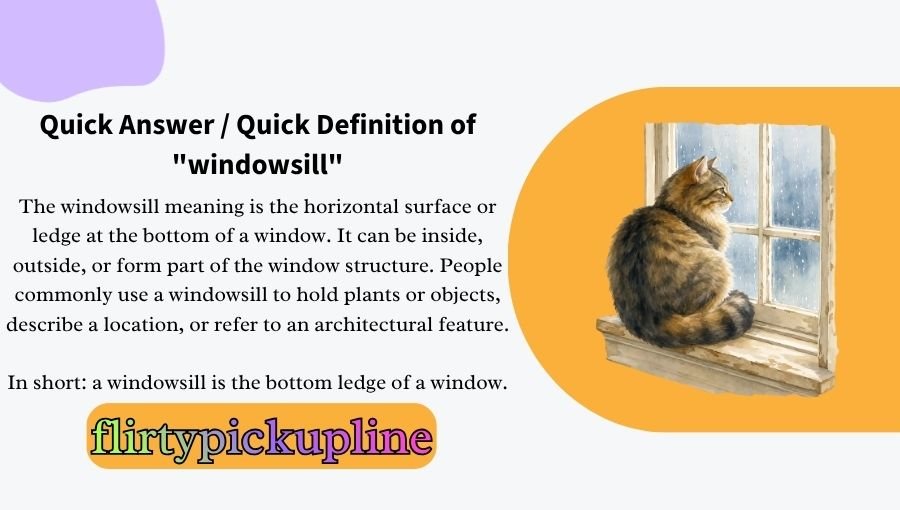
The windowsill meaning is the horizontal surface or ledge at the bottom of a window. It can be inside, outside, or form part of the window structure. People commonly use a windowsill to hold plants or objects, describe a location, or refer to an architectural feature.
In short: a windowsill is the bottom ledge of a window.
Also Read This: Sniffies Meaning
Detailed Meaning Breakdown
Primary Meaning
The primary windowsill meaning refers to the horizontal bottom part of a window opening. In everyday speech, people often mean the flat indoor ledge directly below the glass.
For example: “I left my keys on the windowsill.”
Here, the speaker means the keys are resting on the narrow surface at the bottom of the window. It’s a location word, much like shelf, table, or ledge.
I often notice that people know exactly what a windowsill is when they see one but struggle to define it in words.
Secondary Meanings
In construction and architecture, the term can have a more technical meaning. A sill may be a structural or finishing component that supports part of the window assembly and helps direct water away from the building.
An interior windowsill is usually the visible ledge inside a room. An exterior sill is on the outside and may slope downward to help rainwater drain.
So, the exact windowsill meaning can be slightly broader in building terminology than in casual conversation.
Rare or Misinterpreted Meanings
A windowsill is not the entire window frame. The frame surrounds and holds the window, while the sill is specifically associated with the bottom edge.
It also isn’t automatically the same as a windowsill shelf. A shelf may be installed near a window, while the sill is part of the window structure itself.
Another common mistake is assuming every window has a wide, usable ledge. Some windows have only a narrow sill.
What “windowsill” Means in Different Contexts
In Texting and Messaging
In a text, “windowsill” is usually literal. Someone may use it to explain where they placed something.
Example: “Your package is on the windowsill by the door.”
The intended meaning is simply location. There’s usually no hidden slang meaning. If a friend says, “My coffee is cooling on the windowsill,” they’re describing a real object and place.
The windowsill meaning in messages stays straightforward unless the surrounding conversation is poetic or symbolic.
On Social Media Platforms
On Instagram, windowsills often appear in captions about cozy rooms, plants, sunlight, or home décor: “Sunday morning, coffee, and my little windowsill garden.”
On TikTok, the word may appear in DIY or cleaning videos: “Watch me turn this stained windowsill white again.” The tone is practical and visual.
On Snapchat, it may show up casually in a photo message: “Look who stole my spot on the windowsill,” referring to a pet.
On Threads, users may use it in short observations or jokes, such as: “My plants have better views from the windowsill than I do from my desk.”
Across these platforms, the word remains literal, although images can make it feel cozy, aesthetic, or humorous.
In Dating and Relationships
The windowsill meaning doesn’t have a standard romantic definition. Still, the word can appear in affectionate or intimate descriptions.
For example: “I put the flowers you gave me on the windowsill where they’ll get the morning light.”
The literal meaning is unchanged, but the sentence carries emotional warmth because of the flowers and the relationship.
In a romantic story, someone “waiting by the windowsill” may suggest longing or anticipation. That feeling comes from the wider context, not from the word itself.
In Professional Communication
At work, “windowsill” can appear in office maintenance, interior design, real estate, photography, or construction.
Example: “Please remove personal items from the windowsill before the maintenance inspection.”
This is clear and professional. In technical documents, however, using the exact architectural term may matter. A contractor might distinguish between an interior sill, exterior sill, stool, apron, and frame.
The main risk is vagueness, not tone. If precision matters, describe exactly which part of the window you mean.
Cultural or Regional Differences
The basic windowsill meaning is widely understood across English-speaking regions, but related vocabulary can differ.
In American English, “windowsill” commonly refers to the ledge at the bottom of a window. In architectural discussions, professionals may use more specialized terms. Some people may say “window ledge” in casual speech.
Age doesn’t significantly change the core meaning. A child, homeowner, architect, and gardener may all use the same word, although each may focus on a different purpose.
Tone, Psychology & Why People Use It
Why People Use It & What It Signals Socially
People use “windowsill” because it gives a specific visual location. Saying “the plant is by the window” is less exact than saying “the plant is on the windowsill.”
The word can also create an instant picture. A cat on a windowsill, for example, suggests sunlight, curiosity, and looking outside.
That visual quality explains why the term appears often in fiction, home content, and photography captions. It’s a small detail, but it helps set a scene.
Emotional Layer Behind It
On its own, “windowsill” is neutral. Context gives it emotional color.
Friendly: “Your little note is still on my windowsill.” This can sound warm and sentimental.
Neutral: “Put the form on the windowsill.” This is a simple instruction.
Cold or urgent: “Don’t leave anything on the windowsill.” The firmness comes from “don’t,” not from the noun itself.
That’s a useful distinction. The windowsill meaning doesn’t change with emotion; the surrounding words change how the sentence feels.
10 Real Conversation Examples (Explained)
- Message: “Your sunglasses are on the windowsill.”
Meaning: They were left on the bottom ledge of the window. Tone: Helpful. Likely interpretation: Go look there. - Message: “The cat has claimed the windowsill again.”
Meaning: The cat is sitting there as if it owns the spot. Tone: Playful. Likely interpretation: The cat is comfortable and watching outside. - Message: “Can these herbs survive on a sunny windowsill?”
Meaning: The person is asking about growing plants near window light. Tone: Curious. Likely interpretation: Gardening advice is wanted. - Message: “I found the old photo behind the plant on the windowsill.”
Meaning: A photo was hidden in that location. Tone: Reflective. Likely interpretation: The discovery may have sentimental value. - Message: “Please wipe the windowsill before the guests arrive.”
Meaning: Clean the ledge around the window. Tone: Direct. Likely interpretation: A household task needs doing. - Message: “The rain is pooling on the outside windowsill.”
Meaning: Water is collecting on the exterior part. Tone: Concerned. Likely interpretation: Someone may need to check drainage. - Message: “I put your flowers on the windowsill for the morning sun.”
Meaning: The flowers were placed where they can receive light. Tone: Caring. Likely interpretation: The speaker is trying to preserve them. - Message: “Don’t sit on that windowsill.”
Meaning: The speaker is warning someone not to use it as a seat. Tone: Cautious. Likely interpretation: It may be unsafe or weak. - Message: “That tiny windowsill is perfect for my three succulents.”
Meaning: The ledge is being used as a display and growing space. Tone: Enthusiastic. Likely interpretation: The speaker likes the arrangement. - Message: “She stood by the windowsill and watched him leave.”
Meaning: The phrase describes physical position. Tone: Sad or dramatic. Likely interpretation: The scene suggests separation or longing.
Where Misunderstandings Happen
Context Confusion
The biggest confusion happens when people don’t know whether “windowsill” means the inside ledge or the outside architectural component.
In casual speech, context usually solves the problem. “Put the vase on the windowsill” almost certainly means the indoor surface.
In a repair discussion, though, you may need more detail.
Generational Gap
There isn’t a major generational gap in the windowsill meaning. Older and younger speakers generally understand it the same way.
The difference is exposure. Someone who spends time on DIY projects may know technical window vocabulary, while another person may simply call every edge around a window a “ledge.”
Platform Differences
Social platforms can add visual or aesthetic associations. A “windowsill garden” on Instagram may suggest a carefully styled indoor space, while the same phrase in a hardware forum may lead to practical questions about light and moisture.
The core definition doesn’t change. The purpose of the conversation does.
Similar Words, Symbols, or Abbreviations
| Term | Meaning | How It Differs from windowsill |
|---|---|---|
| Window ledge | A projecting edge by a window | Often used casually as a near-synonym |
| Sill | The bottom part of a window opening | A shorter and sometimes more technical term |
| Window frame | Structure surrounding the window | Includes more than the bottom edge |
| Ledge | A narrow horizontal projecting surface | Can exist anywhere, not only at a window |
| Stool | Interior horizontal window component in some building terms | More specialized architectural vocabulary |
| Apron | Trim beneath an interior window stool | Located below, not on the sill surface |
| Casing | Decorative trim around a window | Usually surrounds the sides and top |
| Windowsill shelf | A shelf attached at or near a window | May be added separately and isn’t necessarily structural |
| Exterior sill | Bottom outside portion of a window | Specifically refers to the outdoor side |
When Not to Use “windowsill”
Professional Risks
Don’t use “windowsill” when a technical report requires a more exact component name.
For example, a building inspection may need to identify flashing, casing, frame, interior stool, or exterior sill. A vague label can create confusion during repairs.
Cultural Risks
There are no major cultural risks attached to the word itself. Still, don’t assume everyone uses the same architectural vocabulary.
If you’re explaining a repair to someone from another region, a plain description can help: “the bottom ledge inside the window.”
Tone Risks
The word is neutral, so tone problems usually come from the sentence around it.
“Move your junk off the windowsill” sounds rude because of “junk.” “Could you clear the windowsill?” sounds polite and professional.
A small wording change can completely alter the social effect.
Expert Tips for Using “windowsill” Correctly
- Use windowsill when you mean the bottom ledge or surface of a window.
- Add “inside” or “outside” when the location could be unclear.
- Use “window frame” when discussing the structure surrounding the glass.
- Choose “ledge” if you mean a similar surface that isn’t specifically part of a window.
- In construction writing, check whether a more technical component name is needed.
- Use the word naturally in location descriptions: “on the windowsill,” “by the windowsill,” or “along the windowsill.”
- Don’t assume a windowsill is strong enough to support a person’s weight.
- Consider sunlight, moisture, and temperature before placing plants or electronics there.
- In creative writing, use the image of a windowsill to build a scene without treating the word itself as a metaphor.
- When explaining the term to a beginner, the simplest definition works best: the ledge at the bottom of a window.
Frequently Asked Questions
What does windowsill mean?
A windowsill is the horizontal ledge or surface at the bottom of a window. In everyday conversation, it usually means the part inside a room where people may place plants, photos, or other small items.
Is a windowsill inside or outside?
It can refer to either side. Most casual conversations mean the indoor ledge, while construction and architectural discussions may distinguish between an interior windowsill and an exterior sill.
Is windowsill one word or two?
Windowsill is normally written as one word. Writing “window sill” may appear in some technical or stylistic contexts, but “windowsill” is the standard everyday spelling.
Is a windowsill the same as a window ledge?
They’re very similar in ordinary speech. “Window ledge” is a descriptive phrase, while “windowsill” is the specific name commonly used for the bottom ledge of a window.
Can a windowsill have a romantic meaning?
Not by itself. However, a windowsill can appear in romantic language when the surrounding situation creates emotion, such as flowers placed there by a partner or someone waiting by a window.
Is windowsill a positive or negative word?
Neither. It’s a neutral noun that names part of a window. A sentence can sound pleasant, sad, strict, or funny depending on the context and the other words around it.
What is the difference between a windowsill and a window frame?
The window frame is the structure that surrounds and holds the window. A windowsill is specifically the horizontal bottom part or ledge. The sill is therefore one distinct area, not the whole frame.
What do people usually put on a windowsill?
Common items include small plants, herbs, candles, decorations, picture frames, and lightweight objects. Before placing anything there, consider sunlight, heat, moisture, and how sturdy the surface is.
Final Summary & Smart Usage Advice
The windowsill meaning is easy to remember: it’s the bottom horizontal ledge or surface of a window. In everyday English, the word usually describes the indoor place where you might set a plant, rest a book, or find a cat enjoying the sun.
The term works naturally in home conversations, gardening advice, décor posts, stories, and simple directions. In professional or construction settings, though, you may need a more precise word if you’re discussing a specific window component.
The most common mistakes are confusing a windowsill with the entire window frame, assuming every sill is wide enough to hold objects, or using the word when “ledge” or a technical architectural term would be clearer.
You also don’t need to search for hidden slang or a secret emotional meaning. Most of the time, the word is completely literal. Any romantic, cozy, sad, or dramatic feeling comes from the scene around it.
Now you can recognize the word, use it naturally, and understand how its meaning shifts slightly between daily conversation and technical settings.
Remember: a windowsill is simply the bottom ledge of a window—context tells you everything else.

Hi, I’m Ryan Mitchell. I work at FlirtyPickUpLine.com, writing about slang, abbreviations, and everyday expressions. I focus on making each meaning clear, useful, and easy to follow.